Install Linux On Hp Stream 7 Tablet
Updated: January 19, 2018
Install Linux On Hp Stream 7 Tablet. Yes, there is probably some workaround to fix grub after the installation but I am not sure what it is.
If you recall, a couple of years ago, I did an impulse purchase of an HP Stream 7 Signature Edition tablet, configured with Windows 8.1, and used it for a brief while, trying to come to terms with its touch nature and its not-so-touch operating system. The experience was somewhat underwhelming.
Then I had the device upgraded to Windows 10 and back - like the Hobbit story, to the Shire and back - because the newest version of the Microsoft flagship operating system was not behaving well. After that, I played with this tablet a handful of times, tried the Windows 10 upgrade again, and then it just sat on a shelf, doing nothing. So I decided to have it donated to an elderly person, with a need for accessibility tools. Hence the Windows 10 again, and this review. Let's see.
Upgrade process
I started by upgrading the operating system in-vivo. The process completed fine and without errors. I was using a Microsoft account on this device, and my settings and options were properly ported over to Windows 10, including device encryption.
Then, while I tried to figure out how to use a scaled-up desktop, magnification and narration, I remembered why I didn't like the device + Windows 10 combo so much the last time. There were tons of issues, and they remained, almost to the letter, two years down the road.
The touch keyboard would not always come up, and I had to manually activate it. The system was lagging, not responding fast enough to my inputs. The device was hot as hell, burning chemical energy in its battery pack. Combined with the small form factor and the lack of suitable applications, it felt like a dead end. And I sure did not intend to hand over a crippled device to an unsuspecting victim.
Reset to default settings
I thought about rolling back to Windows 8 again - and resetting the device, starting fresh. This also meant decrypting the device and wiping the contents of its hard disk. I decided to go with the second option, and let the tablet do its thing.
Some sixteen or seventeen hours later, it was still busy trying to reset everything, and I knew there was a problem. I hard-rebooted the box and ended up with a bootloader menu, telling me things were horribly wrong and that Windows 10 needed repair. I felt the tablet was going to end up as a nice piece of furniture, but then, another hard reboot later, it recovered on its own and continued to boot. Whatever you have to say about Microsoft, it seems to offer a very robust recovery mechanism for its operating system. Sure, you can break it, but this was a nice example of the system taking care of itself.
One Ring to rule them all, One Ring to find them, One Ring to bring them all and in the darkness bind themIn ancient times the Rings of Power were crafted by the Elven-smiths, and Sauron, the Dark Lord, forged the One Ring, filling it with his own. Lord of the rings peoples pdf to doc. THE LORD OF THE RINGS by J. TOLKIEN Part 1: The Fellowship of the Ring Part 2: The Two Towers Part 3: The Return of the King Complete with Index and Full Appendices Three Rings for the Elven-kings under the sky, Seven for the Dwarf-lords in their halls of stone, Nine for Mortal Men doomed to die, One for the Dark Lord on his dark throne. They were clad wholly in white; and the hair of the Lady was of deep gold, and the hair of the Lord Celeborn was of silver long and bright; but no sign of age was upon them, unless it were in the depths of their eyes; for these were keen as lances in the starlight, and yet profound, the wells of deep memory.
At this point, I needed to decide whether to use a local or an online account. Unlike the previous time, I decided to go with the local account option. In fact, if you do not configure a Wireless network, this will be the only available setting.
Eventually, Windows 10 finished its configuration and I had a Windows 10 desktop before me. This time around, things were much fresher - faster, smoother, with fewer errors and bugs. No encryption with the local device. And incorrect tablet orientation, which I could not really fix.
Sorting things out
I realized that Microsoft and HP have not cooperated well on this one, and that whatever generic set of drivers Microsoft was offering, it wasn't good enough to make full use of the tablet's hardware. So I decided to do something you only normally perform on desktops, and that's to grab the whole worth of drivers and firmware from HP and install everything manually. This did unlock the orientation, but it was still wrong.
Orientation issues
After the installation of all the necessary drivers, things were looking slightly better, including improved performance and less heat, but the tablet orientation remained problematic. In a nutshell, it was upside down and 90 degrees to the left. The drivers did not seem to have fixed this, no matter which route I took trying to get this resolved.
After a couple of hours spent digging and searching, I did find out that you may actually have to re-calibrate the device accelerometer - Kionix KXCJ9 - via registry hacks. This sounds like sci-fi, and it really is, and it's probably the deepest configuration hassle I've ever had to do to configure a Windows machine to behave, especially a mobile device like this one that should really be plug-n-play. Or for Microsoft not to allow updates due to incompatibility issues.
A lad named Samuel Pinches has figured the solution for this one - after talking to some Kionix people about undocumented features. There are several registry files available, and you will need to apply them to re-orient the screen. Then logoff, log back in to see if it worked. I needed a total of three changes - flip across both axes and rotate.
Accessibility
Now, the bigger and more important question of day-to-day usage remains, especially people with thick glasses and a somewhat old-fashioned approach to computing. As you've already seen in my previous review, desktop wise, it's a tiny PC. Tablet wise, it's behind competition. Take for instance my recent stint with the Samsung Note 10.1 as well as the fresh new experience with the BQ Aquaris M10 tablet, installed with Android rather than default Ubuntu. In both cases, you have an easy wealth of applications available, and your usage will be rather seamless.
Windows 10 does offer two work modes - tablet and desktop - and you can choose which one you want as a default when you sign in. The difference is somewhere in the taskbar, the displayed icons and system tray, and the system menu versus desktop space behavior. The hybrid approach is commendable.
The tablet mode makes things better, but the apps wonk it.
However, the overall ergonomics still remain off - including the touch keyboard that does not always self-activate on all input fields, as well as the fact that not all components of Windows are designed for touch use. In fact, the smartphone formula is realized so much better, and I'm a happy user of Lumia 950. But with the desktop form factor on a tiny touch screen, well, this does not work. And you have few useful applications to support the ordeal, even if you desire so. Microsoft has its share of programs, but the third-party arsenal is meager, and multimedia isn't trivial as you'd want it.
The keyboard did not pop up when it should. I had to manually activate it. Also, in this case, if you search for
orientation/rotation, the system settings menu will come up blank. There's a lot more room for improvement here.
Then, there's the display scaling factor, which is critical here. To be frank, this worked fine, and I believe every single application I tried scaled well. On the Microsoft side, it was flawless, better than my Windows 8 experience on the 4K display on my sweet Lenovo Y50-70 laptop. I was quite pleased.
Magnification is dreadful on the tiny device, you get all too easily lost. The narration works just fine, including browser usage. I did not test with an online account, so I do not know how well it would work with Cortana and if there's competition of voices. In general, accessibility is overlooked in most operating systems, and overall, Microsoft does a decent job here within the size constraints of the device. Except that Windows 10 itself could do better.
Portrait mode
I also tried using the device in its vertical orientation so to speak, so see how it would fit for prolonged tablet use. Well, it's not too bad actually, but in general, the distinct lack of all-touch ergonomics on a small device is frustrating. The desktop system is designed for big screen with a full keyboard and mouse control. No amount of pretending will actually resolve this. I wonder how this will impact the experience for the intended future user. But then, that in itself will be a test.
Privacy & annoyances
I found the OneDrive ads annoying. They happen even if you use a local account, so you need to go registry deep to get this sorted. I have a long and detailed privacy guide to help you get this in order. Likewise, the lock screen displays nonsense until you change the background to a static picture, and then it goes quiet. Some of the applications show as download tiles in the system menu, but I'm not sure what they stand for.
Background: picture = quiet. Wrong locale btw (I hate when systems try to be smarter than the user; Linux distros do this too).
Windows also nagged about apps causing problems - this was merely changing default file association. So it's not a problem but the fact that I wanted to use a superior program to the one provided with the system.
The device supposedly allows USB connections in the developer mode, just like any other mobile device, but this did not work for me. Maybe I need a reverse-type cable? Also, there's no dedicated screenshot button combo, like on my Lumia phones. I needed to use a timed screenshot function in IrfanView to actually collect images for the review.
Security
As I've noted in my (spring) Windows 10 Creators Update review, you get this new Defender center thingie, which is not strictly related to the Defender security tool you have on the system, and it allows you to check the health of your device at a glance. Makes more sense on a tablet than the desktop, but still unnecessary - sorry, except the fabulous Exploit Protection mechanism introduced in the Fall Update. Then again, for ordinary people, this might make sense, and this is why I decided not to tamper with any security settings on the machine.
General usage
I tried using the device as is - pretending that it's a fully fledged computer only tiny, and then a tablet to pit against the wolves of Android. Well, to enjoy it, you really need a bigger screen and a proper mouse. Pinching stuff on a tiny desktop with high scaling isn't fun. Tablet wise, this is no phone, and it feels like that. Updates worked fine at least.
Another question that I have is, how will the intended user cope with the lack of touch software, and if this is going to be a problem? I know several elderly who use tablets, mostly of the Apple kind, and they are quite pleased. I don't really know of any Android tablet user above the age of 60, so I can't say anything there. This will definitely be a curious little experiment.
Conclusion
There are two levels of concluding that need to be done here. First, on the device level, Microsoft could have done a much better job. Robust upgrades, fine, bad desktop experience due to missing drivers, not fine and not excusable.
Second, we have the post-setup usage, and it's a mixed bag. Microsoft tries its best to accommodate users with accessibility needs, and the desktop scaling and narration work pretty well. Tablet and desktop modes are another nod toward size and usage model compromise. This isn't the best idea, nor is the lack of touch software.
In you look at a typical phone, you use it as is, no questions and no confusion. On a tablet, you will sometimes be forced to use the desktop mode, as the tools and programs only offer that. Given that this runs on an Intel processor, it's pretty much guaranteed. And when you have to do that, it's a small device, you only have your fingers, and if you're elderly with bad eyesight, this is not going to be pretty. You also have no alternative, as there are no good apps in the Windows Store to compensate for that.
All that said, I believe the simple and square design should appeal to people who want a hassle-free setup. Hell, I love it. It's majestic on the phone. But this is, under the hood, still a small desktop. Without the space to spread its wings. And without the air to make the tablet breathe. Tricky. I'm skeptical, but it's better than having the device rot on a shelf. Well, time will tell. To be continued. Maybe.
Cheers.
I have had such good luck upgrading some of my collection of small form factor tablets that I decided to take on another one today. The HP Stream 7 was my next target for Windows 10 Version 1803.
Yesterday it was the NuVision TM800W610L (8 inch) and the TM101W610L Solo Draw (10 inch) tablets. They were both running Windows 10 Version 1709 from last fall and all the subsequent cumulative updates that are released. The Windows 10 April 2018 Update was pushed out to seekers so I went seeking it from Windows Update and started the install. It took about 2 1/2 hours but both tablets are happily, albeit slowly, running Windows 10 Version 1803. They are even supporting Timeline data being synched across my device ecosystem.
So today I decided to attempt an upgrade on one of my trouble maker tablets – the HP Stream 7. This one has been sitting unused for quite a while – ever since I was using it for test builds as a Windows Insider. In fact, the main reason it was not being used was because an installed build expired and I could not access the system.
I knew a clean install was necessary but it also wasn’t an urgent issue either. Well today, I dug out my wired USB mouse, keyboard, and created an installation flash drive using the Media Creation Tool that had the Windows 10 April 2018 Update on it. For the HP Stream 7 it had to be the 32 bit version of Windows. By default, the Media Creation Tool will match the architecture of the device the drive is being built on. In my case that was a 64 bit system. The HP Stream 7 requires 32 bit so just be sure to make that change before building out the install media.
While that was in progress I went to HP’s support website and downloaded the drivers for the HP Stream 7.
Now there are different models of the HP Stream 7, I have the 5709 one, so make sure you are on the support page for that version. Otherwise you could have some difficulties with the drivers matching the hardware.
Download all of the drivers from that page and save them in a folder called something like HP Stream 7 Drivers. Do not expand them – just save them in their downloaded executable file state.
Tip: HP uses cryptic numbers for their software downloads so as you grab each one of these rename it to match what driver it contains such as graphics, sensors, wireless, Bluetooth, etc.
By now your install drive that is being created by the Media Creation Tool should be ready. If not let it finish up and when it is done – leave the flash drive plugged in.
Copy the folder of drivers that you downloaded and renamed earlier to the flash drive with the installation files on it. You will use those later after the operating system is installed.
Now after you have completely charged the HP Stream 7 you will need that wired mouse, keyboard, USB flash drive with the Windows 10 install files on it, a small unpowered USB hub like they give out as swag at some trade shows, and a USB Type A to MicroUSB OTG cable.
Plug the OTG cable into the hub and plug that into the HP Stream 7. Next plug in the mouse, keyboard and USB drive into the small hub. Everything is now wired up and ready to begin.
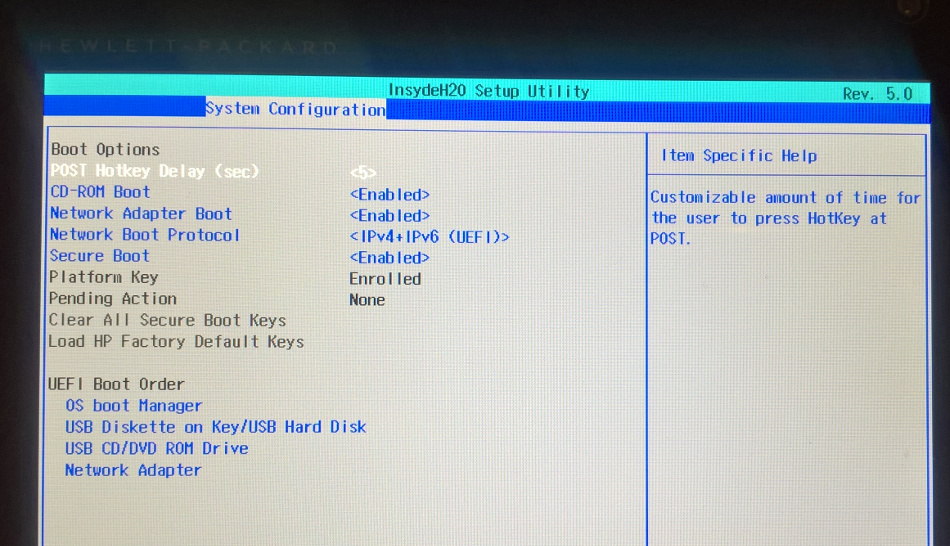
On the HP Stream 7 (Model 5709) you access the boot menu by pressing and holding the Volume Down key and then the Power key. Hold them both until you see the screen come on and then let go. You will see the Startup Menu and the option you want to select is F9 Boot Drive Options. On the next screen you will see a couple of options and one of them should match your USB flash drive. The other two on my HP Stream 7 were listed as OS Boot Manager and Boot from UEFI File.
After that selection is made the system will begin the clean install process on the device. This process goes much like any other system you have ever clean installed Windows 10. Using the wired mouse and keyboard make your choices along the way and eventually your system will reboot and begin the Out of Box Experience (OOBE) to set the system up. Once you are all done then you will be at the Lock Screen and be able to log in with the credentials you provided during the OOBE.
Again – if you have ever reset or clean installed a Windows 10 device – this process is very familiar.
Once you are logged into the system it is time to install your drivers. Remember they are stored on the same USB flash drive that is already plugged in from installing Windows 10.
Since they are executables no need for separate extractions. Just select the file to begin the install process.
I installed the HP Stream 7 drivers in this order:
- Touch
- Audio
- Graphics
- Sensors
Wireless and Bluetooth were working with out of the box drivers in Windows 10 so I did not install them separately.
I also had a firmware and BIOS update which I then installed in that order.
At this point it is time to update Microsoft Store apps, install the ones you like to use, and set the system up for daily use. My recommendation is to consider this a consumption only system. I will say it was easy to use Near Share with this device to other machines running the Windows 10 April 2018 Update so that makes sharing easy.
Look – this little tablet is not a powerhouse. Just look at these specs:
- Intel Atom CPU Z3735G (1.33GHz)
- 1 GB RAM
- 32 GB Storage
That is not going to run photo editing apps, etc. but it will do web browsing, social media, and similar low end activities.
So set your expectations appropriately and enjoy having a little handheld consumption device to use as a second screen on the couch when watching TV or sitting on the back porch!
Enjoy – now I am off to find my next small form factor tablet victim – errr – opportunity for an upgrade!
HP Stream 7 – Windows 10 April 2018 Update Install Images
- Small USB Hub and OTG Cable
- Wired Hot Rod Mouse
- Setup Starting
- Initial File Copy
- Setup OOBE
- Final Stage
- Drivers/BIOS Install
- System Specs
- Microsoft Edge Welcome
- Martin Bostock on November 3, 2018 at 8:18 AM
Thank you so much for that Richard you have saved my Stream 7 – so clogged with update debris and the kids stuff that it could no longer update itself and was in a sulky death spiral! Mine’s an early 5700na and it is now running fine and as fast as something with such short legs can be expected to run!
The Windows 10 Home version is 1607